Tewkesbury Academy Local Arrangements
These Health and Safety Arrangements should be read in conjunction with other relevant policies and procedures. This includes, but is not limited to, the Safeguarding Policy, Fire Arrangements, First Aid Policy, Supporting students with medical needs including intimate care, Offsite trips guidance etc. Together, these documents form a comprehensive framework to ensure the safety and wellbeing of all students, staff, and visitors. Staff are expected to be familiar with and adhere to all applicable policies.
Accident Reporting, Recording and Investigation
- All accidents, including near misses, must be reported using the online accident reporting system, accessible via the Navigator page.
- It is the responsibility of the attending staff member or designated first aider to document any accident involving students, staff, or visitors as soon as possible.
- Every employee has a duty to ensure that all incidents are accurately and promptly recorded.
- Any fatal injuries, major injuries, or dangerous occurrences must be reported immediately to the Health and Safety team.
- Incidents that meet the criteria under RIDDOR (Reporting of Injuries, Diseases and Dangerous Occurrences Regulations) will be reported to the Health and Safety Executive (HSE) by a member of the CLF Health and Safety team, following submission of the major accident form by the Academy.
- Parents, carers, or other nominated contacts will be informed of any accident involving a student as soon as practicable.
- The Academy will regularly review the accident reporting dashboard to identify patterns or trends.
- Where necessary, appropriate measures will be implemented to prevent recurrence.
- Findings and actions will be discussed as part of the Academy’s Health and Safety Committee meetings.
- Where appropriate, an investigation will be conducted by the Principal and/or Operations Manager to determine the root cause of the incident and to mitigate future risks.
- In certain cases, the investigation may be supported or followed up by a member of the CLF Health and Safety team.
Asbestos
- The asbestos survey is located online, in the main reception, site office and in the Critical Incident grab bag.
- Members of the site team have attended Asbestos Awareness Training and have/will undertake regular refresher training.
- All contractors arriving to work on site will have a mini-induction delivered by premises team before work commences. They are also required to sign and confirm they have seen the asbestos register in relation to the area they will be working in or the activities they will be undertaking.
- Before any intrusive works to the fabric of the building are undertaken a Refurbishment / Demolition (R & D) asbestos survey is required. Our CLF asbestos specialist Karen Williams must be consulted before any work commences. The survey will be fully intrusive and involve destructive inspection, as necessary, to gain access to all areas including those that may be difficult to reach.
- All required permit to works will be issued by Premises Manager.
- An asbestos management plan is located with the logbook in the site office
- The contractors signing in logbook is located in the site office
- Staff responsible for monitoring and inspecting asbestos containing material are the site team
- All staff must report any damage to identified areas immediately to Steve Brown, Premises Manager
- If asbestos is damaged the area will be sealed off immediately and locked to prevent unauthorised access – Follow the Emergency procedures as outlined in the Asbestos Policy.
- Location maps of asbestos containing material is located in the asbestos survey. Hard copies are available in the main office, site office and in the critical incident plan.
Compliance
- Compliance responsibilities are managed by the Estates Manager in collaboration with the Premises Manager.
- Internal compliance checks (e.g. fire call points, emergency lighting, water temperature monitoring, and flushing) are conducted by the Premises Team.
- A compliance contract has been awarded to BAM Asset Management for external statutory inspections and servicing.
- External compliance checks (e.g. boiler servicing and maintenance, emergency lighting annual testing, lightning conductor inspections) are carried out by the CLF compliance contractor, with records maintained accordingly.
- Specialist inspections for playground and gym equipment are conducted by independent contractors, currently Sport & Play and Gym Gear.
Contractors and Visitors
- All visitors and contractors must report to the main office to sign in, verify DBS status, receive a visitor badge, and be issued with site specific health and safety information. They must sign out upon departure.
- .Contractors must be selected from the CLF-approved PQQ (Pre-Qualification Questionnaire) list available on CLiF. If not listed, contractors must complete the PQQ process before starting work.
- For urgent works involving non-PQQ contractors, the Premises Team must ensure they have assessed competence before work begins.
- Pre-Work Requirements:
Risk assessments and method statements must be agreed in writing.
Pre-contract checks (e.g. asbestos or ground surveys) may be required depending on the nature of the work.
- Relevant staff are informed of the work scope, location, timing, and duration.
- Contractors must sign the Contractor Authorisation to Work (CAW) form.
- Any changes to work activities must be discussed with the Principal, Premises Team, or Operations Manager.
- All contractors, sub-contractors, and self-employed workers must follow local safety rules and the Academy’s/School’s Health and Safety Policy.
- Contractor performance is monitored throughout.
- Unsafe practices must be stopped immediately until safety standards are met.
- Any completed work is reviewed with the Premises Team or Operations Manager, and follow-up actions are agreed as needed.
Contractors undertaking Hot Works
Hot work must be strictly controlled through a Hot Work Permit, issued jointly by the Academy and the contractor. The Estates Team must be notified in advance, and the relevant permit documentation must be completed and submitted to the Estates Contracts Manager.
To ensure appropriate insurance coverage, the Estates Contracts Manager must receive the completed forms at least 48 hours prior to the commencement of work, allowing time for notification to the Academy’s/School’s insurers and arrangement of any additional cover required.
COSHH (Control of Substances Hazardous to Health)
- An up-to-date inventory of all hazardous substances on site is maintained by department leads and the Operations Manager. Copies are stored in the COSHH Folder and the Emergency Grab Bag.
- All regularly used substances are accompanied by Material Safety Data Sheets (MSDS)
- Any new substances displaying a hazard warning symbol and posing a significant risk due to use, misuse, quantity, or storage must undergo a COSHH risk assessment. A COSHH risk assessment template is available in the Health and Safety Manual on CLiF. Findings, including required PPE, safe handling, and storage procedures, must be communicated to all relevant staff.
- The delivery of hazardous substances is coordinated by the relevant department (e.g. Science or Premises Team) and if possible, this is scheduled outside of academic hours. Deliveries are either temporarily stored in the relevant department’s safe storage.
- Cleaning contractors are expected to operate under their own COSHH procedures, which must align with the Academy’s arrangements.
All decanted substances must be clearly labelled with the product name, dilution rates, and relevant safety information.
- Departments such as Science, Design & Technology, and Art are responsible for maintaining their own procedures for the safe storage, handling, and use of hazardous substances, in line with their respective departmental Health and Safety Policies.
Defect Reporting Procedures
- All staff are responsible for maintaining a safe working environment and must report any defective, damaged, poorly maintained, or untested equipment via the Premises Helpdesk tile on the Academy Navigator page as soon as possible.
- Where there is an imminent risk, make the Premises Team/Operations Manager know immediately.
- Any faulty equipment must be immediately taken out of use, clearly labelled as “Do Not Use”, and, where necessary, isolated to prevent further risk. The issue must then be reported through the appropriate system as outlined above.
Display Screen Equipment (DSE)
- The Academy is responsible for conducting DSE risk assessments for staff who are classified as “users” under the DSE Regulations. A user is typically someone who uses display screen equipment (e.g. a computer or laptop) daily for an hour or more, such as administrative staff or the Operations Manager.
- DSE assessments are completed every two years, or sooner if there are changes to equipment, office layout, or staffing.
- Completed self-assessments will be reviewed and discussed with their line manager. Any required actions must be documented and followed up appropriately.
- Staff to complete DSE training via Nimble.
- All DSE users are entitled to a biennial eyesight test conducted by a qualified optician. If corrective lenses are recommended specifically for DSE use, staff should consult their Operations Manager for further guidance.
- For more information and access to the DSE user risk assessment and manager sign-off form, please refer to the CLF DSE User Guidance available on CLiF.
Electrical Equipment (Fixed and Portable)
- All electrical faults must be reported immediately to the Operations Manager, Premises Manager, or via the Premises Helpdesk. Faulty fittings (e.g. cracked sockets) must be isolated, clearly labelled “Do Not Use”, and scheduled for repair.
- Electrical sockets must not be overloaded. Staff should have a basic understanding of electrical safety to avoid overloading circuits.
- Extension leads should only be used temporarily and must be fully unwound during use to prevent overheating.
- Staff are not permitted to bring personal electrical items onto the premises unless the item is new or has undergone a recent PAT test.
- All fixed installations are inspected by a qualified contractor every five years, in line with statutory requirements.
- PAT is carried out annually via BAM by qualified electricians or competent trained staff. During testing, any defective items are either repaired or removed from use, labelled accordingly, and stored securely.
- Hirers, contractors, and visitors must ensure that any electrical equipment brought onto the premises has a valid PAT certificate and is safe to use.
- The Academy reserves the right to conduct random checks to ensure compliance.
Expectant or New Mothers
In the event that a member of staff becomes a new or expectant mother, the Academy will take appropriate measures to safeguard their health and safety in the workplace. A dedicated risk assessment will be conducted and documented through a one-to-one consultation. This assessment will be regularly reviewed and updated throughout the pregnancy and upon return from maternity leave to ensure ongoing support and compliance.
Fire and Emergency Procedures
- The Academy will implement and use the CLF Fire Arrangements template which must be read and understood in conjunction with these arrangements.
- Three fire drills will be completed over the course of the year.
- The fire arrangements will be reviewed annually.
- The responsible person is Kathleen McGillycuddy, Principal
- The assembly point(s)
Y7 & Y8 E-Block tennis courts
Y9 Hardstanding between E-Block tennis courts and sports hall
Y10 & Y11 AWP Tennis courts
Y12 & Y13 Outside dance studio
Professional Services, Non-Tutors, Visitors & Contractors: K-Block – Assembly Point 1
- A list of Fire Wardens can be found HERE
First Aid / Mental Health First Aid
- The Academy will implement and use the CLF First Aid Policy which must be read and understood in conjunction with these arrangements.
- A list of qualified First Aiders, holding nationally recognised certifications, is displayed on the TA Staff Portal. These individuals are authorised to administer first aid.
- Details of certified Mental Health First Aiders are displayed on the TA Staff Portal. These individuals are trained to support and signpost those experiencing mental health challenges or emotional distress.
- Notices indicating the location of first aid facilities are displayed at key points throughout the premises.
- The designated First Aid Room is located in the Head of Years Office (K-Block)
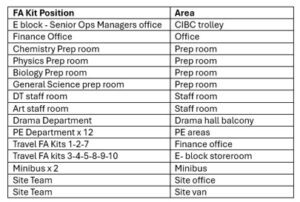
- First aid boxes are available at the following locations:

- Chris Zoers (Emergency First Responder) is responsible for ensuring that all first aid boxes are adequately stocked and that contents are replenished and in date, and this is recorded. First aid boxes do not contain any medication, tablets, creams, or ointments.
- If deemed necessary by a First Aider or the Principal, an injured person will be sent directly to hospital, typically via ambulance. Parents or carers will be informed immediately.
- No injured person will be sent to hospital unaccompanied. If a parent or guardian cannot be reached, a designated adult will accompany the individual.
Glass and Glazing
- All academies will refer to the model Glazing Risk Assessment available on CLiF and have had an initial glazing survey (Applied Products) to determine that the standard of glazing is compliant in critical locations.
- The condition of glazing will be routinely monitored as part of regular site inspections and visual checks.
- If there are any concerns regarding the condition of glazing such as damage, non-compliance, or uncertainty about whether safety glazing is in place, a formal glazing survey must be arranged through the Estates Team.
Health and Safety Committees
- The Health and Safety Committee operates as an independent body, meeting at least three times per academic year. Its primary function is to coordinate and integrate all aspects of health and safety management across the Academy.
- The committee operates under agreed Terms of Reference, which define its roles and responsibilities.
- Committee Membership may include
- Principal or a member of the Senior Leadership Team (SLT)
- Operations Manager
- Representative from the Central Health and Safety Team
- Premises Manager
- Trade Union Representative (where applicable)
- Heads of Science, Art, PE, or Design & Technology, or their nominated technicians
- SENCO and/or Designated Safeguarding Lead (DSL)
- A standard agenda template for committee meetings is available in the Health and Safety Manual on CLiF.
Infectious Diseases
- The Academy adheres to the latest UK Health Security Agency (UKHSA) guidance, including the “Guidance on Infection Control in Schools and Other Childcare Settings.”
- Specific guidance on managing infectious diseases (A to Z) can be accessed via the following link: Managing Specific infectious disease: A to Z
- The Academy follows the CLF model risk assessment template for infection control which is reviewed and adapted as necessary. For further advice, staff should contact the Southwest Health Protection Team (SWHPT) or the Health and Safety Team.
- In the event of a rise in infectious disease cases, Julia Whybrow, Senior Operations Manager will contact the local SWHPT for further guidance and support.
- Biohazard spill kits (disposable packs) are available in the site office for safe and effective management of bodily fluids.
- Colour-coded cleaning equipment (mop heads, dustpans, brushes) and Personal Protective Equipment (PPE) are stored in all cleaning cupboards to ensure proper hygiene protocols are followed.
Kiln
For Kiln Operating Standards please refer to CLiF – Health & Safety Manual – Kilns
- Only trained and competent staff are permitted to operate the kiln. A current risk assessment, along with operating and emergency procedures, is in place and shared with relevant staff members.
- The kiln undergoes an annual inspection by BAM (Celtic Kilncare) to ensure safe operation and compliance.
- Thermal protective gloves are provided and stored in the kiln room for safe handling during operation.
- The emergency power cut-off switch for the kiln is located at outside the cage on the wall (A8).
- Firing schedules must be coordinated with the CLF Contracts Team, Premises Team, Operations Manager and in line with Zurich insurance standards.
Law Poster
In accordance with the Health and Safety Information for Employees Regulations, the Academy is required to either:
- Display the approved Health and Safety Law Poster in a prominent location, or
- Provide each employee with an equivalent leaflet.
This poster outlines the responsibilities of both employers and employees in maintaining a safe working environment. It also includes contact details for seeking advice or raising concerns about workplace safety.
The official Health and Safety Law Poster is displayed in the main reception, all staff rooms and the Sports Centre.
Legionella
- The CLF Legionella Management Policy V4 must be read and understood.
- A copy of the Legionella risk assessment is stored available online (Premises Sharepoint). BAM is contracted to perform water testing in accordance with L8 guidance.
The site team are responsible for conducting weekly flushing, temperature monitoring, and other required checks.
Lettings
- All lettings must be approved by the Head of Leisure and Lettings, and where appropriate, by the Academy Principal or Operations Manager.
- Delegated approval may also be given by Deputy Managers and Leisure Attendants.
- All hirers must complete and sign the CLF Leisure and Lettings Terms and Conditions.
- Lettings at HPA, WHA, BA, HWA, JCA, TA, and KOA are managed via CLF School Hire, where the full Terms and Conditions are available.
- A customer handbook is provided to customers upon booking to ensure that they are aware of the emergency contact details and procedures.
- Staff on duty are available to assist, and direct customers as needed.
- Clear emergency procedures are in place. Both the Academy and the hirer must understand and adhere to their respective responsibilities in the event of an emergency.
- The Academy may request risk assessments from hirers, particularly for organised activities.
- All organised clubs or groups must provide evidence of adequate insurance coverage.
- Hirers are required to report any damage, equipment failure, or building faults to the Academy immediately.
- All accidents, incidents, and near misses must be reported using the Academy’s online reporting system.
Lockdown
The Academy is equipped with a dedicated lockdown alarm system. In cases where such a system is not in place, alternative procedures for initiating a lockdown are clearly defined and documented.
All staff members are thoroughly familiar with the lockdown protocols, including both partial and full lockdown scenarios. Key elements include:
- Students are regularly informed of lockdown procedures through assemblies and other communication channels.
- Lockdown drills are conducted at least twice annually to ensure preparedness and reinforce understanding across the school community.
Lone/ Remote Working
The Academy has conducted comprehensive lone working risk assessments to ensure the safety and wellbeing of staff working in isolation or outside of regular hours. The following control measures are in place:
- Staff are not permitted to work at height or engage in other high-risk tasks while working alone.
- A reporting or buddy system is implemented to ensure regular check-ins and accountability during lone working periods.
- Specific arrangements are in place for staff working during school holidays, including designated contact persons and access protocols.
Manual Handling
The Academy is committed to ensuring the safety of all staff involved in manual handling tasks. The following procedures and expectations are in place:
- Manual handling training is mandatory for identified staff and must be completed via Nimble every three years.
- Staff must assess any manual handling activity for potential hazards. If an item is too heavy or awkward for one person to lift safely, appropriate control measures must be implemented (e.g., team lifting, use of trolleys or mechanical aids).
- A manual handling risk assessment must be completed and documented for any activity that poses a risk of injury, particularly for staff who regularly engage in such tasks.
- Staff are responsible for ensuring they are physically capable of safely performing manual handling tasks. Any concerns should be raised with their line manager.
- Expectant mothers must carry out manual handling tasks in accordance with their individual risk assessments, ensuring all activities are conducted safely.
- Staff with relevant medical conditions or those recovering from surgery must consult with their line manager before undertaking manual handling tasks.
Medication
- The Academy will implement and use the CLF Supporting Students with Medical Needs including Intimate Care template Policy which must be read and understood in conjunction with these arrangements.
- In accordance with CLF requirements, the Academy ensures that a sufficient number of staff members are trained in the safe administration of medication.
- A current list of staff who have completed the Administering Medication training are displayed on the TA Staff Portal.
Personal Protective Equipment
The Academy is committed to ensuring the health and safety of all staff and students through the appropriate use of Personal Protective Equipment (PPE). The following procedures are in place:
- PPE will be provided free of charge where it is identified as a necessary control measure.
- All PPE must be fit for purpose and compatible with other required protective equipment.
- Heads of Department or Line Managers are responsible for the periodic inspection of PPE and for ensuring it is worn correctly by staff and students when required.
- Designated staff (e.g., Technicians or relevant personnel) are responsible for ensuring their PPE is regularly cleaned and maintained in good condition.
- All staff are expected to use PPE appropriately and consistently wherever it is provided.
- Clear and sufficient signage will be displayed in areas where PPE is required.
- Students will receive appropriate information, instruction, and supervision regarding the use of PPE when it is required as a control measure.
PE/Gym Equipment
The Academy is committed to maintaining a safe environment for physical education. The following procedures are in place:
- All staff are responsible for visually inspecting PE apparatus before each use to ensure it is safe and fit for purpose.
- Any faults or defects must be reported immediately via the Premises Helpdesk.
- Equipment identified as damaged or unsafe will be taken out of use until repaired or replaced.
- PE/Gym equipment is inspected annually and are conducted by independent contractors, currently Sport & Play and Gym Gear. Records of these inspections are kept in the online contractors folder, and any remedial actions are completed within the specified timeframes.
- A comprehensive risk assessment is in place for all gym activities and equipment.
Radioactive Sources
Where radioactive sources are held or used, the Academy adheres strictly to national safety standards and CLEAPSS guidance. The following measures are in place:
- A competent Radiation Protection Adviser (RPA) is appointed to oversee the safe management of radioactive materials. This role is currently held by CLEAPSS.
- The Academy -based Radiation Protection Supervisor (RPS) is Dr Lindsey Newman who is required to complete refresher training every five years.
- Following the RPA’s biennial inspection, all recommendations must be implemented promptly and within the specified timeframes.
- The Head of Science and the RPS share responsibility for maintaining accurate and up-to-date records of all radioactive sources.
- All procedures align with CLEAPSS guidance as outlined in Managing Ionising Radiations and Radioactive Sources.
- The Science Department maintains its own detailed procedures for the safe storage, handling, and use of radioactive materials, as documented in the Science Department Health and Safety Policy.
Risk Assessments
The Academy is committed to maintaining a proactive approach to risk management. The following procedures ensure that risk assessments are effectively implemented and accessible:
- Risk assessments are completed for all activities where there is a foreseeable risk of injury or harm.
- Risk assessments are available to staff via the shared drive online.
- Model templates and a statutory/recommended risk assessment matrix are available on CLiF to support consistent and compliant documentation.
- Each department must maintain up to date copies of relevant risk assessments, ensuring they are readily accessible to all staff.
- Staff are actively involved in the adoption, implementation, review, and amendment of risk assessments to ensure relevance and practicality.
- All staff must familiarise themselves with the risk assessments relevant to their roles and report any concerns or required updates to their line manager.
- Risk assessments are reviewed at least annually, or sooner if there are significant changes to activities, incidents, or identified risks.
- Where necessary, individual risk assessments for pupils are developed in collaboration with the SENCO and DSL.
- Guidance and training on conducting risk assessments are available in the Health & Safety Manual on CLiF and through Nimble.
Safeguarding
- The Academy Council fully recognises its responsibility under the Education Act 2011 and the Safeguarding Vulnerable Groups Act 2006 to safeguard and promote the welfare of children and to work together with other agencies to ensure adequate arrangements within our Academy to identify, assess, and support those children who are suffering harm.
- The Academy has a Safeguarding Policy that was last reviewed on 1 September 2024.
- The Academy DSL is Jade Buck
- The Local Authority Designated Safeguarding Officer is Nigel Hatten.
- The CLF Designated Safeguarding Officer is Steve Bane.
- All staff have been provided with safeguarding information and have undertaken annual safeguarding training.
Security
The Academy is committed to maintaining a safe and secure environment for all students, staff, and visitors. The following measures are in place:
- The Premises Manager is responsible for site security and conducts regular inspections of boundary walls, fencing, access points, outbuildings, and external lighting to ensure integrity and functionality.
- All staff are expected to challenge any individual on site who is not wearing a visitor badge. If it is safe to do so, the individual should be escorted to reception for verification. In the event that an intruder becomes aggressive or threatening, staff must not engage and should seek immediate assistance.
- The Academy enforces a zero-tolerance policy regarding violence, threats, or abusive behaviour directed at staff or students.
- Any incidents involving verbal abuse or threatening behaviour from parents, visitors, or students must be reported immediately to the Principal for appropriate action.
- Security concerns can be escalated to the CLF Central team via the Ops Manager or Principal.
Smoking/ Vaping
The Academy enforces a strict no smoking and no vaping policy across the entire site, including all buildings, grounds, and car parks.
- Clear “No Smoking / No Vaping” signage is prominently displayed at all building entrances and other key locations to ensure awareness and compliance.
Staff Consultation
The Academy is committed to maintaining open and effective communication with staff on all health and safety matters. The following arrangements are in place:
- The Academy Council, through the Principal, ensures full and proper consultation with employees regarding health and safety issues.
- There is no mandatory requirement for a union-appointed health and safety representative at the Academy.
- Staff wishing to act as union appointed safety representatives must either:
Have been employed by the Academy for the preceding two years, or
Possess sufficient experience in a similar role or employment setting.
- The Academy adheres to the Safety Representatives and Safety Committees Regulations 1977 (as amended), which outlines the legal duties of employers in consulting with staff on health and safety matters.
Training
The Academy is committed to fostering a strong health and safety culture through effective and ongoing training. Key arrangements include:
- Needs are identified through risk assessments, audits, appraisals, and changes in roles or responsibilities, guided by the Academy’s training matrix.
- Training is overseen by the Operations Manager and/or relevant Head of Department. Records are maintained on the Single Central Record (SCR), with certificates stored in individual personnel files.
- All staff receive a structured induction covering site-specific and departmental procedures (e.g. Art, DT, Science), with completion formally recorded.
- Most training is refreshed every three years. Specialist modules (e.g. PASMA, DATA, radioactive sources, pressure vessels) require renewal every five years.
- Only staff trained by the Design and Technology Association (DATA) may operate DT machinery.
- All staff must complete annual training via Nimble, including:
Workplace Safety for New Starters or
Workplace Safety & Security Refresher
- Completion data supports the annual training needs analysis and ensures staff remain competent and accountable for safety.
Transport
- Staff and authorised volunteers must read and follow the CLF Minibus Guidance v9.docx.
- A formal booking system is in place, including a key sign-in/out process.
- Pre-use vehicle checks must be completed, recorded, and are stored in the Admin Minibus Folder. Any significant issues must be reported to Juliet Sirrell, Deputy Operations Manager. Weekly site checks undertaken by the site team or on Parago.
- Valid Permit 19 certificates must be clearly displayed in all minibuses.
- Staff using their own vehicles must comply with the CLF Driving at Work Policy.
- When transporting students, staff must:
Undergo licence and MOT checks.
Implement and adapt the “Driving Students in Own Vehicles” risk assessment.
Hold appropriate business insurance.
- The Deputy Operations Manager conducts annual checks to confirm:
Valid driving licences
Completion of MIDAS training
Appropriate insurance and MOT certification (where applicable)
- Only transport operators from the approved EVOLVE list may be used.
- If an unlisted provider is considered, the Health & Safety team must be consulted in advance.
Trips/off site activities
The Academy follows a dedicated trips procedure aligned with CLF and OEAP (Outdoor Education Advisory Panel) guidance, as outlined in the EVOLVE system.
- The Academy will implement and use The CLF Offsite Trips and Adventure Activities Guidance.
- All offsite trips that meet requirements must be submitted via Evolve. Routine local sports fixtures, such as inter-school matches or league games, are not submitted through EVOLVE, as they are considered part of the academy’s regular, low-risk activities and are managed under established departmental procedures
- The nominated Educational Visits Coordinator (EVC) is Rob Young (Assistant Principal).
- The EVC will review all trip plans, including transport, activities, and risk assessments, and submit them to the Principal for final approval.
- Category C trips (adventurous, residential, or overseas) require:
Principal sign-off.
Submission to the Health & Safety Team via EVOLVE for final approval (minimum six weeks in advance).
For adventurous activities led by external providers, checks will be made to ensure:
A valid AALA licence is held.
The provider has a Learning Outside the Classroom (LOtC) Quality Badge.
Violent and challenging behaviour
- The academy does not tolerate any form of violence, aggression, or threatening behaviour towards staff, pupils, or visitors.
- Individual risk assessments will be conducted for students known to exhibit challenging behaviour, with input from relevant staff and external professionals where appropriate.
- Designated staff will receive regular training in de-escalation techniques, conflict resolution, and safe intervention strategies, including the lawful use of reasonable force.
- All incidents of violent or aggressive behaviour must be reported promptly using the online incident reporting system and reviewed by senior leadership.
- Staff and pupils affected by violent incidents will be offered appropriate support, including access to counselling services if needed.
- Tailored behaviour support plans will be developed for pupils who present ongoing challenges, in collaboration with parents/carers and relevant agencies.
- The academy is committed to maintaining a safe and respectful environment for all and will take proactive steps to prevent and address violent behaviour.
Waste
- Suitable waste collection bins are provided in strategic locations throughout the Academy to prevent overfilling.
- Waste containers are emptied regularly by cleaning or premises staff to maintain hygiene and safety.
- Segregated waste areas, secure from vandalism and unauthorised access is located in the East Gate car-park bin store.
- An authorised person or a member of the premises team will be equipped with appropriate personal protective equipment (PPE) for safe waste handling.
- Suitable arrangements are in place for the disposal of hazardous waste generated through school activities.
- Hazardous waste, including chemical disposal, is managed in compliance with regulations via the Waste Regulation Authority or a licensed and competent contractor.
- Waste is collected by Viola according to the following schedule: Weekly.
Wellbeing and Mental Health
- Where poor Mental Health is experienced, the academy will:
- Have Mental Health Leads in place to support staff that may be experiencing poor mental health and/or work-related stress.
- Encourage open conversations about mental health and the support available when employees are struggling and offer appropriate workplace adjustments to employees who require them.
- Develop and promote mental health awareness among employees by making information, tools and support accessible
- Provide mental health awareness among employees by making information, tools and support accessible.
- Promote effective people management to ensure all employees have a regular conversation about their health and well-being with their line manager, supervisor or organisational leader and train and support line managers and supervisors in effective management practices.
- Routinely monitor employee mental health and wellbeing by understanding available data, talking to employees, and understanding risk factors.
- Adopts the HSE Management Standards for work-related stress, applying a step-by-step risk assessment approach to identify and manage the six causes of stress at work.
- Support is available through the HR Department, Occupational Health, and the Employee Assistance Programme (EAP), which staff are encouraged to access as needed.
Work Equipment
- All work equipment is fully inspected upon installation to ensure it meets safety standards.
- An annual recorded maintenance and service inspection is carried out by a competent person for all work equipment.
- Maintenance and servicing records are maintained and readily accessible.
- Staff, technicians, and premises teams are responsible for conducting and recording pre-use visual checks of equipment within their departments.
- Employees are not permitted to use or bring in personal equipment for work purposes.
- Heads of Department and line managers must ensure that:
Equipment is used appropriately.
Users receive appropriate training where necessary.
Suitable and sufficient risk assessments are completed prior to equipment use.
- Examples of work equipment include site staff power tools, D&T machinery and tools, access equipment, lifting equipment, heavy plant equipment, kilns, etc.
Work Experience Pupils
A nominated person, in collaboration with the appointed external organisation, will provide guidance and oversight for student work experience placements.
- The staff member organising the placement, together with the workplace provider, is responsible for conducting the initial risk assessment for the young person.
- The appointed external organisation will ensure that all relevant and appropriate checks are completed on the work experience provider.
- The placement employer is expected to deliver a health and safety induction to the student at the start of the placement.
- For placements within the Academy, students will be monitored and supervised by their assigned class teacher and/or support staff, with liaison as needed with the nominated person.
Working at Height
- Activities requiring work at height are identified and eliminated wherever possible.
- Where elimination is not feasible, all reasonable steps are taken to reduce the risk to the lowest practicable level.
- Risk assessments must be conducted prior to any work at height; this is the responsibility of the site team to ensure this takes place.
- The Academy has access to appropriate equipment for safe working at height.
- Only ladders compliant with BS EN131 standards are permitted; domestic ladders are not allowed under any circumstances.
Workplace Inspections (Site Walks)
- Regular workplace inspections (minimum three times annually) will be conducted to identify hazards and unsafe conditions, with appropriate remedial actions taken.
- The Premises Manager, in collaboration with the Operations Manager, is responsible for monitoring and controlling premises-related hazards.
- Site walks may be accompanied by:
Principal
Member of SLT or Head of Department
Operations Manager
Premises Team
Designated Safeguarding Lead (DSL)
Health & Safety Officer
Students
Union Representative
- Findings from site walks will be documented in a written report and shared with the Health & Safety Committee.