
This policy is intended to:
Bursary entitlement is assessed against two main criteria: Student Eligibility and Student Financial Need.
Student Eligibility is defined as:
Student Financial Need is defined as:
It should be noted that for items of equipment including books and laptops, students must return them once they have completed their study programme so they can be used again by another student where appropriate. If keeping equipment on site is the best way of ensuring this happens, provisions have the right to set this as a condition.
Bursaries cannot be used for the following:
There are three types of bursary available:
Vulnerable Groups Bursary
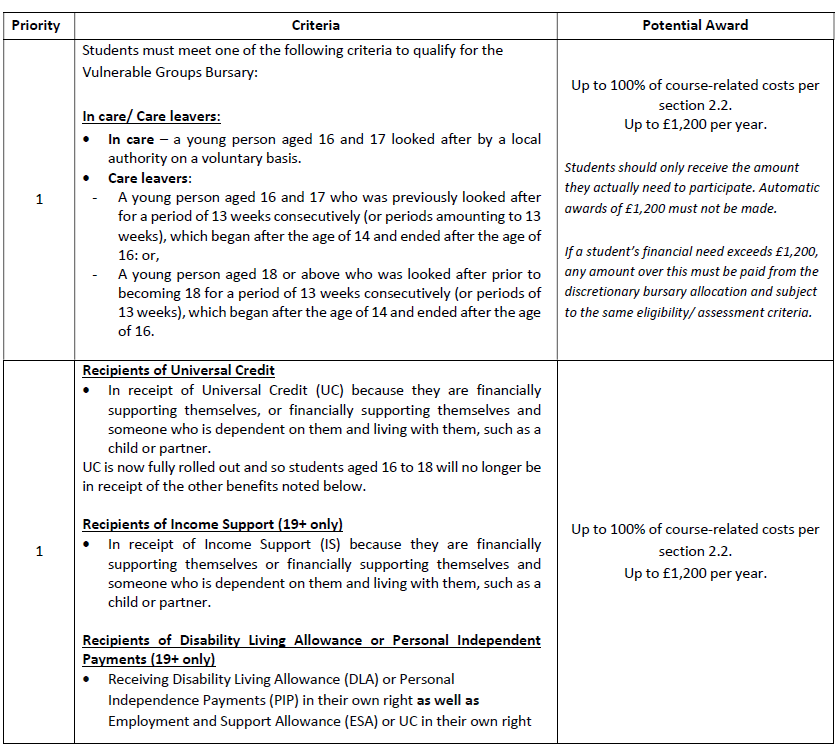
Discretionary Bursary
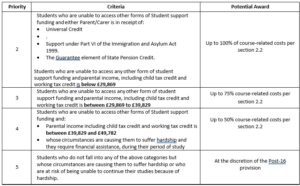
Please see Appendix 2 for the calculations used to determine the Priority Group income bandings.
Discretionary bursary funding is limited, as such it should be noted that students who are eligible for support are not automatically entitled to bursaries. The level of support offered may be at variance with the above based on overall cohort need relative to available funding. Where available funding is insufficient to meet the awards for students in Priority Groups 2-4 outlined above, a percentage reduction should be applied across all discretionary groups so that bursary awards match available funding
Emergency Meal support
Where the academy identifies a student that is in real need emergency meal support can be provided on the days a student is in school. This is a short term arrangement and the following applies:
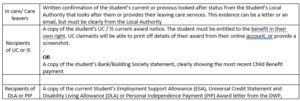
Vulnerable Groups Bursary (Priority Group 1) Evidence
Evidence of students’ eligibility for Vulnerable Groups bursary funding must be submitted each year, even if this means re-submitting the same evidence as the previous year (i.e. to evidence looked-after status). This is in line with requirements for Vulnerable Group funding claims submitted to the Student Bursary Support Service.
Discretionary Bursary (Priority Groups 2 – 4) Evidence
The criteria for Priority Groups 2 – 4 require checks on Parent(s) / Carer(s) (P/C) household income that must be submitted at the beginning of the students’ studies. In subsequent years students must provide conformation on the Applicaa portal that their circumstances have not changed to the extent that their level of bursary entitlement would be affected per the conditions of their Priority Group.
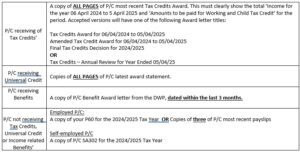
Student applications should be submitted and administered via the Applicaa online portal and must be supported with accompanying evidence uploaded to the portal.
Evidence must be reviewed against students’ applications by the academy to ensure that the evidence submitted meets policy requirements and is in alignment with the student’s application.
Paper application forms are available to students to ensure that all students are able to access the bursary application process. A copy of the paper application form can be found in Appendix 3. All applications received on paper application forms are to be reviewed and uploaded by Academy staff to administer the students’ bursary on the online portal with the original paperwork and supporting documents returned to the student.
It is imperative that students are able to access support in applying for and subsequently administering their bursaries. Provisions must therefore clearly publish up-to-date information for a contact within the academy that they are able to liaise with in the event of queries.
Where a student has any concerns or queries regarding their bursary application, in the first instance they should e-mail the bursary inbox for the relevant academy. The complaint will then be reviewed by the CLF bursary panel.
The panel will comprise three members of CLF staff, with one finance representative and two Post-16 representatives. The academy receiving the complaint will reach out to colleagues to create the panel reviewing complaints as they are received.
Should a student feel that their concerns remain outstanding, they can then request that the complaint is escalated through the academy formal complaints process
Bursary payments will be made to students as 10 monthly payments per the below schedule. The payment timetable is structured to ensure that students are not out of pocket and access to their course is not limited by a shortfall in bursary support;

All students are encouraged to submit their applications by the September deadline. Late applications will be accepted per the deadlines outlined above and will follow the same payment arrangements as other bursary payments
Where possible, support should be provided in-kind rather than as a monetary payment. The below table notes the preferred route through which course-related costs should be met. It is understood that this may sometimes not be practical and so it is expected that provisions exercise reasonable discretion in deviating from these guidelines, ensuring that evidence requirements are met and records are maintained at student level in the Applicaa system in doing so
Payments will be backdated by a maximum of 3 months in line with CLF finance policy, particularly as it is recognised that students can face challenges in securing the evidence required to process their bursary applications
Whilst late applications are accepted, applications will close once the bursary budget has been fully utilised
Payment of bursary will be linked to attendance where possible, to ensure that bursary payments match actual financial need.
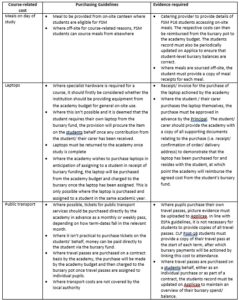
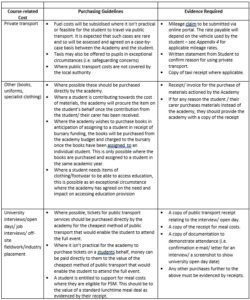

Funding for Vulnerable Groups (Priority 1): Draw-down
Funding claims for vulnerable groups will be centrally manged and claimed.
Funding should be drawn down from the Student Bursary Support Service (SBSS) on an ad-hoc basis throughout the year, as soon as is practicable once new Students have been identified and verified.
Funding can be drawn down by completing and submitting a bursary for vulnerable groups funding claim via the SBSS online portal by 31st July of the relevant academic year. Any submissions made after this date will not be paid.
Only the amount of funding needed should be drawn down based on the student’s financial need – the full £1,200 should not be drawn down if not required.
The SBSS portal doesn’t function as a filing system, and so a copy of funding claims submitted must be retained, along with records of funding paid to them through the claims process.
Where unused bursaries for vulnerable groups accrue (i.e. where there is a difference between predicted and actual financial need, a student leaves etc), this funding should be recycled to offset funding claims for other eligible students until 30 April. Where there remains unused funding after this, P16 provisions can add this to their discretionary bursary allocation from 1 May.
Where incorrect submissions have been made, the respective funding should be recycled on subsequent Vulnerable Group funding claims. If there are no others students eligible for vulnerable group funding however, this allocation cannot be added to the discretionary bursary (as it has been claimed in error), and the central team must contact SBSS to return the funds
Funding for Priority Groups 2 -4: Discretionary Bursary Allocation
The ESFA makes a lump-sum discretionary bursary allocation for provisions to distribute to individual Students based on 2 elements; 1) financial disadvantage; 2) student costs to support travel and industry placements. Please see Appendix 5 for more information on the calculation.
Where a Post-16 provision operates through subcontracts or from more than one location across England, the allocation is made to the lead institution. The lead institution is responsible for ensuring the bursary fund is administered appropriately at each site, and that students are able to access support.
Allocations are paid by the ESFA to the Academy in 2 payments : 2/3 in September and 1/3 in April
Up to 5% of the bursary allocation may be used for administrative costs relating to the 16 to 19 Bursary Fund per the ESFA guidance.
The Trust will use the allocation to fund the costs of the online bursary management software and to support central staffing costs incurred in administering the bursary process.
Any remaining allocation can be applied for by academies to support costs directly relating to the administration of bursaries. Requests should be submitted to the Deputy Finance Director.
Unspent bursary funds may be carried over to the bursary fund for the next academic year. The funds are ringfenced for this purpose and cannot support the academy budget.
Provisions must be able to confirm the amount of unspent funds carried forward from the previous year, and they must ensure that they fully use unspent funds before using the new academic year allocation.
Unspent funds of more than a year must be returned and reported by 31 March.
The central CLF Treasury Team will maintain a reconciliation of the bursary by Academy to track bursary spend and balances.
Bursary awards are made based on hardship. This must be substantiated by evidence at the point of application, which will be securely retained for 6 years per ESFA guidance.
16 to 19 Bursary Funds are subject to audit and all bursary applications and supporting information are must be maintained at student level.
4.3 The CLF operates a bursary application and administration process through an online bursary management platform that supports and satisfies audit requirements. Academy staff retain a role in ensuring and demonstrating that the guidelines per this policy document are observed.
The implementation of this policy and its processes will not discriminate against students on the basis of any protected characteristics as set out in equalities legislation
This policy will be reviewed annually in line with the annual ESFA 16 to 19 Bursary Fund guidance
This review will be completed each year to support the new round of applications for the subsequent academic year.
Any circumstances or situations not covered by this policy must be resolved with reference to the ESFA 16 to 19 Bursary Fund Guide for the 2025-26 Academic Year, with central finance guidance and approval sought as appropriate.