
Tewkesbury Academy aims to ensure that our pupils are Ready, Responsible and Respectful young people.
– We aspire for pupils to thrive academically; to flourish and grow as young people. When they leave us, they will have a strong sense of self, their place in the world and the agency to fulfil their potential.
– We aspire to create a learning community where staff and pupils are engaged, challenged, and inspired, and thus will take risks, make mistakes, and learn from them.
– We aspire to meet the needs of every person in the Academy. We will embed a supportive and compassionate culture in which the whole person is nurtured, and the voice of pupils is valued.
– We aspire for our Academy to be the community’s school of choice underpinned by trusting and respectful relationships between staff, pupils, and parents.
We will achieve all of this by ensuring that pupils feel a sense of belonging and acceptance within the academy, that pupils’ efforts, skills and values are recognised to build self-esteem, that learning environments feel “safe”, encouraging active participation, risk taking and positive engagement and, through maintaining high standards underpinned by the expectation that everyone works hard and tries their best.
Strong relationships, empowering learning environments and consistent boundaries and well-understood routines that everyone knows and understands are the key to psychological safety, enabling every person in our community to explore, develop and express their individual identities, to thrive academically; to flourish and grow as young people.
By establishing Tewkesbury Academy as a welcoming, warm, caring and friendly place, with strong conditions for learning and clear expectations, pupils will have disruption free classrooms in which they are active learners and teachers will have disruption free classrooms full of motivated, responsive and engaged pupils.
Aims:
This policy aims to:
– Create a positive culture that promotes excellent behaviour, ensuring that all pupils can learn in a calm, safe, and supportive environment
– To optimise the psychological safety of learners so that there is a culture of learning, ambition, and achievement throughout the school, where no learning time is wasted through lesson disruption
– Establish a whole-school approach to maintaining high standards of behaviour that reflect the values of the school
– Outline the expectations and consequences of behaviour
– Provide a consistent approach to behaviour management that is applied equally to all pupils
– Define what we consider to be unacceptable behaviour, including bullying and discrimination
This policy acknowledges our legal duty to make reasonable adjustments for disabled children, children with special educational needs (SEND) and those with protected characteristics.
Research into cognitive science has demonstrated the unequivocal links between learning and the emotional centres within the brain. Feelings of belonging, acceptance and safety are critical for effective learning. Psychological safety is “a belief that one will not be punished or humiliated for speaking up with ideas, questions, concerns or mistakes”[1]. Pupils will develop psychological safety when they feel welcome and accepted, where there is a calm and familiar environment and where it is safe to engage in the learning process, to ask questions, experiment and to make mistakes. Repeated, positive interactions with calm, compassionate and emotionally regulated staff can result in enhanced pupil well-being and more effective learning. This is true for all pupils, but even more so for any pupils experiencing mental health challenges, additional barriers to learning or a history of trauma.
Psychological safety is the key to empowerment. It is created through strong relationships, the development of learning environments where it feels safe to take risks, and through consistent boundaries and well understood routines. The first 2 stages of Psychological Safety are Inclusion Safety and Learner Safety.
Inclusion Safety (Strong Relationships).
Staff create Inclusion Safety through building and sustaining trusting and respectful relationships with pupils through a multitude of positive interactions across the day, week, term, and academic year. These interactions result in a sense of pupil belonging and acceptance.
Actions that build positive relationships include:
– Meeting and greeting pupils at the classroom door e.g. “Morning Sasha, good to see you”, “Afternoon Alfie, great work yesterday”.
– Welcome statements prior to challenge. e.g. “Morning Sabrina. Good to see you. Do you have a reason for not being in full uniform?”, “Casey it’s great that you are contributing to the discussion, but I have asked Amir to answer so please do not call out (that is your first reminder)”
– Presumption of innocence when challenging e.g. “What is your reason for being out of lessons?” (rather than “Why are you out of your lesson?”)
– Positive attention first in all lessons; identify pupils getting things right before identifying a pupil not meeting expectations e.g. “We’re moving into quality audience, fab Amina already looking at me”.
– Recognising effort and achievement e.g. “that’s great effort”, “top answer”, “love that”
– Praise linked to desired behaviour e.g. “Great Lauren, not only have you given me an answer, but you have explained the reasons for your answer”.
– Praise linked to personal qualities e.g. “Zac you have focused brilliantly on this task for 15 minutes, that shows your ambition to do well”, “Zara you have been the first person willing to explain your understanding – that’s a really brave thing to do”
– Recording positive behaviours on Bromcom
– Showing knowledge of a pupil’s outside interests e.g. “Zara, how did the match go this weekend?”, “Alex, you were fab in yesterday’s Christmas Concert”.
– Showing that you care e.g. “Jamie, you are clearly angry about something what has happened? Can I help with anything?”
– Showing a pupil that they are noticed e.g. “Good to see you back in school Daisy, missed you yesterday”, “I’ll be with you in 1 minute Casey, just need to see Alfie first”.
– Showing a pupil that you are committed to supporting them e.g. “Alan, I have an enlarged copy for you”, “Sam, let’s do the first two examples together to check that you’ve got it”.
– Making positive calls to parents / carers.
– Acknowledging a mistake and making amends “Amandeep, I am so sorry, I said I would come to you next but have then been distracted by a question over here. I will be with you right now”.
Psychological safety is built upon staff displaying a welcoming, relaxed and confident demeanour. Staff should smile, talk calmly and slowly, display open, non-confrontational body language and give pupils personal space. Staff should always allow a pupil to finish their sentence (even when we disagree with what is being said) and should never use sarcasm.
However, staff are only human and there are a wide variety of reasons when we may find it more difficult to manage our response to our emotions. In these situations, staff should model emotional literacy to the pupils e.g. “I am feeling less patient today because I am suffering from a bad back”, model regulation techniques “I can feel myself getting frustrated, I am going to take 5 deep breaths” and provide an apology when they have got things wrong. This is hugely powerful in modelling to pupils that everyone can make mistakes and that relationships can be repaired and strengthened through restorative actions.
Despite displaying respect, empathy and compassion, it is vital that staff maintain high standards and are rigorous in their challenge of pupils when expectations are not met. When challenging a pupil, staff should always remain calm, should speak slowly and assertively (not aggressively) and should explicitly identify the behaviour that they are challenging. Pupils should be reminded of the expectations, should be provided with a choice of next steps, and should be given take-up time to make the right decision. At all times staff should aim to present themselves as calm, relaxed, patient and adamant. Where a pupil continues to refuse to comply with the staff direction, the incident should be recorded on Bromcom and support sought from the duty member of staff, the pastoral team or SLT.
Learner Safety
Learner safety is to feel safe to engage in the learning process, to ask questions, to experiment and even to make mistakes – not if, but when you make them. Learner safety is the enabling precondition that creates the curiosity and willingness to be brave in personal learning. However, children, adolescents and adults all bring inhibitions and anxiety to the learning process. These will be even greater for those experiencing anxiety, mental health issues and additional barriers to learning.
An environment that offers learner safety unlocks potential, cultivating confidence, resilience and independence. The creation of such an environment is not a passive act – it is an active decision to create a supportive and encouraging environment, to commit to be patient with learners, to deliver effective learning strategies and to provide the resources to enable all to learn. Focus should be on pupil effort rather than aptitude. Critically there should be no stigma, no shame or no embarrassment associated with failure, it is simply a stepping-stone to learning. We should reward failure because it is not failure – it is progress.
Actions that build learner safety include:
– The use of familiar routines in your teaching
– Linking new knowledge to prior learning
– Effective modelling
– Working together as a class prior to independent learning (I DO-WE DO-YOU DO)
– The recognition and celebration of effort, participation and risk-taking
– Repeated and explicit recognition and validation of error as an integral part of learning
– The use of low-stakes quizzing
– The use of talk prior to writing
– The use of whiteboards
– Think, pair, share
– The offer of other pupil / teacher support where a pupil is reluctant to participate
– The provision of model / correct answers for reference
– Elements of pupil autonomy / choice within learning tasks
– Teacher response to errors. Rather than immediate correction, facilitate further exploration of pupil thinking “Tell me more, what are your reasons for this answer?”
Consistent Boundaries and Well-Understood Routines.
Psychological safety and feelings of belonging are maximised within familiar environments with well understood expectations and routines. Paradoxically, pupils who have experienced trauma, unregulated home environments, anxiety and additional learning needs crave for, and benefit the most from, consistent boundaries that are enacted within a supportive and compassionate environment. Where pupil behaviour is outside of these expectations, we will apply fair and proportionate sanctions in a consistent manner.
Tewkesbury Academy Learning Routines
– Meet and Greet – Teachers at classroom doors and visible throughout the day to check uniform and welcome pupils into lesson
– Ready to Learn – Lesson Entry. Pupils sit in allocated seats, remove coats, put bags on the floor, a silent starter ready for pupils to complete
– Respectful learners – Pupils actively engaged in all learning tasks within the classroom
– End of Lesson – Pupils stand behind chairs, uniform checked, leave lesson when dismissed by the class teacher
We believe in rewarding effort, recognising achievement, and encouraging pupils to aspire to exceed our expectations. Rewards are a very powerful tool for staff to use. A pupil, whose achievements are recognised in any way, whether publicly or in private, is more likely to make a positive impact within the Academy community. A clear framework for rewards and praise allows all pupils to be recognised, rewarded, celebrated, and recorded.
What should we praise? The things which encourage a ‘growth mindset’.
– Meeting the Tewkesbury Academy standards of being Ready, Responsible and Respectful citizens
– Kindness and thoughtfulness to other pupils
– Service to the school and the community
– Collective endeavour in order to achieve challenging goals
We use an extensive range of rewards: e.g., verbal praise, positive points on Bromcom, certificates, postcards, vouchers, celebration assemblies, class rewards and treats, sports awards and reward activities/trips. Pupils’ achievement points are recorded on Bromcom. Achievement points are also communicated to Parents/Carers.
Definitions
Misbehaviour is defined as:
· Disruption in lessons, in corridors between lessons, and at break and lunchtimes
· Non-completion of classwork or homework
· Poor attitude
· Incorrect uniform
Serious misbehaviour is defined as:
· Repeated breaches of the school rules
· Any form of bullying
· Sexual violence, such as rape, assault by penetration, or sexual assault (intentional sexual touching without consent)
· Sexual harassment, meaning unwanted conduct of a sexual nature, such as:
· Sexual comments
· Sexual jokes or taunting
· Physical behaviour such as interfering with clothes
· Online sexual harassment, such as unwanted sexual comments and messages (including on social media), sharing of nude or semi-nude images and/or videos, or sharing of unwanted explicit content
· Vandalism
· Theft
· Fighting
· Smoking
· Racist, sexist, homophobic or discriminatory behaviour
· Possession of any prohibited items. These are:
· Knives or weapons
· Alcohol
· Illegal drugs
· Stolen items
· Tobacco and cigarette papers
· E-cigarettes or vapes
· Fireworks
· Pornographic images
· Laser Pens
· Any article a staff member reasonably suspects has been, or is likely to be, used to commit an offence, or to cause personal injury to, or damage to the property of, any person (including the pupil)
Bullying is defined as the repetitive, intentional harming of one person or group by another person or group, where the relationship involves an imbalance of power.
Bullying is, therefore:
– Deliberately hurtful
– Repeated, often over a period of time
– Difficult to defend against
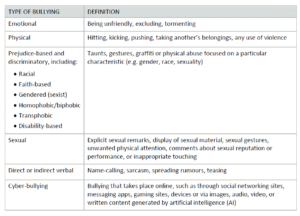
Bullying can include:
The Principal is responsible for:
– Reviewing and approving this behaviour policy
– Ensuring that the school environment encourages positive behaviour
– Ensuring that staff deal effectively with poor behaviour
– Monitoring how staff implement this policy to ensure rewards and sanctions are applied consistently to all groups of pupils
– Ensuring that all staff understand the behavioural expectations and the importance of maintaining them
– Providing new staff with a clear induction into the school’s behavioural culture to ensure they understand its rules and routines, and how best to support all pupils to participate fully
– Offering appropriate training in behaviour management, and the impact of special educational needs and disabilities (SEND) and mental health needs on behaviour, to any staff who require it, so they can fulfil their duties set out in this policy
– Ensuring this policy works alongside the safeguarding policy to offer pupils both sanctions and support when necessary
The Leadership Team is responsible for:
– Supporting staff in ensuring there is a positive climate for learning.
– Conducting drop-ins to support staff with pupils/classes.
– Leading ‘on call’
– Supporting staff with ‘on call’
– Supporting ‘The Tiered Graduated Response’ including placing pupils on ‘SLT Report’ and supporting Internal Fixed Term Exclusion
– Supervising Internal Fixed Term Exclusion and Reflection as part of a rota.
– Supporting with restorative conversations where necessary
– Providing Academy Council with termly updates on behaviour trends
– Collecting, collating and monitoring whole Academy data
– Ensuring staff are provided with continuing professional development to support positive behaviour management
Heads of Year and the Extended Leadership Team are responsible for:
– Investigating behaviour incidents
– Implementing and developing proactive strategies for individual pupils to promote positive behaviour within the year group
– Conducting drop- ins across the Academy to support a positive learning environment.
– Promoting a positive climate for learning
– Communicating with home following behaviour incidents
– Supporting staff with behaviour incidents through ‘on call’
– Carrying out Restorative Practice where appropriate and support staff with restorative conversations following a ‘Call Out’
– Revisiting and reminding pupils regarding expectations and Academy systems through assemblies and use of tutor time
– Collecting, collating and monitoring year group data on attendance, punctuality and behaviour
– Ensuring new pupils to Academy arriving throughout the academic year are clear on expectations and school systems – as part of the induction process
– Monitoring, logging and communicating outcomes of bullying and peer on peer abuse incidents
– Attending Academy Behaviour Support Plan and Fixed Term Exclusion review meetings.
Heads of Department are responsible for:
– Conducting drop-ins within their subject areas
– Giving advice, and supporting staff, to deal with behaviour issues.
– Monitoring praise using Bromcom.
– Monitoring incidents, that take place within the department using Bromcom and ‘Call Out’ data and implementing behaviour strategies to support pupils and staff.
– Supporting staff with restorative conversations following multiple ‘Call Out’ removal from lessons.
– Supporting staff with ongoing subject behaviour issues by communicating with parents and ‘The Tiered Graduated Response’ strategies.
– Communicating behaviour concerns and staff training needs in line management meetings.
Teachers and Staff are responsible for:
– Creating a calm and safe environment for pupils
– Establishing and maintaining clear boundaries of acceptable pupil behaviour
– Implementing the behaviour policy consistently
– Communicating the school’s expectations, routines, values and standards through teaching behaviour and in every interaction with pupils
– Modelling expected behaviour and positive relationships
– Providing a personalised approach to the specific behavioural needs of particular pupils
– Considering the impact of their own behaviour on the school culture and how they can uphold school rules and expectations
– Challenging pupils to meet the school’s expectations
– The senior leadership team (SLT) will support staff in responding to behaviour incidents
Parents and carers are responsible for:
– Parents and carers, where possible, should:
– Get to know the school’s behaviour policy and reinforce it at home where appropriate
– Support their child in adhering to the school’s behaviour policy
– Inform the school of any changes in circumstances that may affect their child’s behaviour
– Discuss any behavioural concerns with the class teacher promptly
– Take part in any pastoral work following misbehaviour (for example, attending reviews of specific behaviour interventions)
– Raise any concerns about the management of behaviour with the school directly, while continuing to work in partnership with the school
– Take part in the life of the school and its culture
– The school will endeavour to build a positive relationship with parents and carers by keeping them informed about developments in their child’s behaviour and the school’s policy and working in collaboration with them to tackle behavioural issues
Pupils are responsible for:
Pupils will be made aware of the following during their induction into the behaviour culture:
– The expected standard of behaviour they should be displaying at school
– That they have a duty to follow the behaviour policy
– The school’s key rules and routines
– The rewards they can earn for meeting the behaviour standards, and the consequences they will face if they don’t meet the standards
– The pastoral support that is available to them to help them meet the behaviour standards
Pupils will be supported to meet the behaviour standards and will be provided with repeated induction sessions wherever appropriate.
Pupils will be supported to develop an understanding of the school’s behaviour policy and wider culture.
Pupils will be asked to give feedback on their experience of the behaviour culture to support the evaluation, improvement and implementation of the behaviour policy.
Extra support and induction will be provided for pupils who are mid-phase arrivals.
No pupil has the right to disrupt the learning of others. Teachers will have disruption free classrooms in which they can teach, and pupils will have disruption free classrooms in which they can learn.
Class teachers apply a consistent approach to classroom behaviour management which provides pupils with the opportunity to self-correct their conduct. Appropriate behaviour referral ensures that most well-behaved pupils continue to be taught effectively by removing individuals who repeatedly disrupt the learning of others. Teachers will log all behaviour incidents on Bromcom.
All pupils are expected to:
· Arrive on time to the lesson
· Enter the classroom calmly as directed by a member of staff and complete the silent starter
· Sit silently whilst the register is taken
· Listen in silence whilst the member of staff leading the lesson speaks
· Raise their hand to ask a question without calling out
· Work exceptionally hard without disrupting any other pupil learning
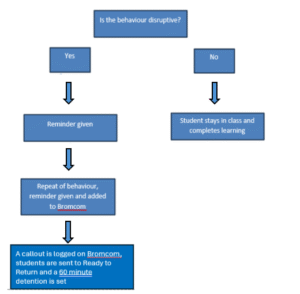
If a pupil fails to meet any of these simple expectations, they will receive a reminder of the expectations.
The second time during a lesson that a pupil fails to meet these expectations will result in the pupil being given a formal reminder recorded on Bromcom. Further disruption will result in the pupil being sent to the Ready to Return Room for the remainder of the lesson. The pupil will also incur a 60-minute same day after-school detention.
In class behaviour flow chart
When a pupil’s behaviour falls below the standard that can reasonably be expected of them, staff will respond to restore a calm and safe learning environment, and to prevent recurrence of misbehaviour.
Staff will endeavour to create a predictable environment by always challenging behaviour that falls short of the standards, and by responding in a consistent, fair and proportionate manner, so pupils know with certainty that misbehaviour will always be addressed.
De-escalation techniques can be used to help prevent further behaviour issues arising, such as the use of pre-arranged scripts and phrases.
All pupils will be treated equitably under the policy, with any factors that contributed to the behavioural incident identified and considered.
When giving behaviour sanctions, staff will also consider what support could be offered to a pupil to help them to meet behaviour standards in the future.
The school may use one or more of the following sanctions in response to unacceptable behaviour:
– Sending the pupil out of the class
– A verbal reprimand and reminder of the expectations of behaviour
– Detention after school
– School-based community service, such as tidying a classroom
– Referring the pupil to a senior member of staff
– Letter or phone call home to parents/carers
– Agreeing a behaviour contract
– Putting a pupil ‘on report’
– Removal of the pupil from the classroom to Ready to Return
– Time spent in Reflection
– Pupil could receive a Fixed Term Exclusion
– Permanent exclusion, in the most serious of circumstances
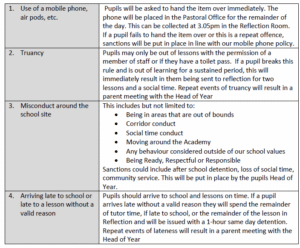
Involvement in serious incidents may lead to range of wider sanctions including an extended period in Reflection, Fixed Term Exclusion, an Off-Site Direction (OSD), or potentially Permanent Exclusion (PEX).
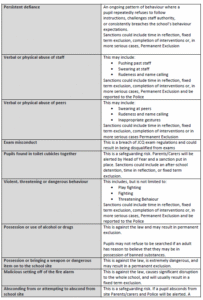
Serious incidents warrant a parental meeting. We may also need to report the incident to the police following this guidance:
Serious incidents include, but are not limited to:
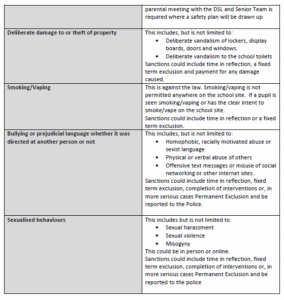
Tewkesbury Academy has the power to sanction pupils for their behaviour outside of the school premises and outside of school hours (DfE: Behaviour and discipline in schools (January 2016)). This includes when pupils:
– Take part in any school-organised or school-related activity
– Are travelling to or from school
– Are wearing school uniform
– Or behaviour at any other time that poses a threat to another pupil or member of the public or that could adversely affect the reputation of the school.
We wish for pupils to be proud of their belonging to Tewkesbury Academy, and to be positive ambassadors for the school.
Whilst wearing their Tewkesbury Academy uniform, when travelling to and from school, pupils will be representatives of the school and will play their part in shaping the perceptions of the Academy within their communities.
Positive behaviours, such as respectful interactions with adults, helpful responses and friendly exchanges with younger pupils, will all help build positive perceptions and may encourage parents / carers to consider Tewkesbury Academy as the right educational environment for their children.
On the other hand, negative behaviours such as anti-social conduct (e.g. malicious knocking on doors), boisterous, threatening and intimidating behaviours to others and / or deliberate damage or graffiti to property all have the opposite effect, and will damage the reputation of the academy within the local community.
Negative behaviours in the community that damage the reputation of Tewkesbury Academy will be classified under the umbrella term “Bringing the Academy into Disrepute”. These will be treated as serious incidents and will result in sanctions and parent meetings.
At Tewkesbury Academy we will embed a compassionate culture where we support pupils in building the skills to make positive choices. Where we have ongoing concerns about pupil behaviours, both within and outside of the Academy, we will follow a staged process of increasing levels of support (Graduated Response). This will include initial assessments of need. Identified need may then be addressed through additional academic intervention, pastoral support, access to our Reset provision, internal and external mentoring, access to programmes to build self-confidence and resilience, mental health support and placement within other schools.
There are circumstances when it is appropriate for staff in schools and colleges to use ‘reasonable force’ to safeguard children. The term ‘reasonable force’ covers the broad range of actions used by staff that involve a degree of physical contact to control or restrain children. This can range from guiding a child to safety by the arm, to more extreme circumstances such as breaking up a fight or where a child needs to be restrained to prevent violence or injury. ‘Reasonable’ in these circumstances means ‘using no more force than is needed’. The use of force may involve either passive physical contact, such as standing between pupils or blocking a pupil’s path, or active physical contact such as leading a pupil by the arm out of the classroom.
Searching can play a critical role in ensuring that schools are safe environments for all pupils and staff. It is a vital measure to safeguard and promote staff and pupil welfare, and to maintain high standards of behaviour through which pupils can learn and thrive.
Principals, and staff they authorise, have a statutory power to search a pupil or their possessions, including electronic devices, where they have reasonable grounds to suspect that the pupil may have a prohibited item listed below or any other item that the school rules identify as an item which may be searched for.
The list of prohibited items is:
– knives and weapons;
– alcohol;
– illegal drugs, including paraphernalia;
– stolen items;
– any article, including electronic devices, that the member of staff reasonably suspects has been, or is likely to be used:
o to commit an offence, or
o to cause harm or personal injury to, or damage to property of; any person (including the pupil).
– an article specified in regulations:
o tobacco and cigarette papers, including vapes;
o fireworks; and
o pornographic images.
Under common law, school staff have the power to search a pupil for any item and will always seek co-operation of the pupil before. The member of staff should ensure the pupil understands the reason for the search and how it will be conducted so that their agreement is informed. If the pupil does not co-operate, further sanctions may be applied. A record of the search will be put in CPOMS and parents will be informed.
Being in possession of a prohibited item – especially knives, weapons, illegal drugs or stolen items – may mean that the pupil is involved, or at risk of being involved, in anti-social or criminal behaviour including gang involvement, and in some cases may be involved in child criminal exploitation. A search may play a vital role in identifying pupils who may benefit from early help or a referral to the local authority children’s social care services. See Keeping Children Safe in Education and Working Together to Safeguard Children.
The school’s behaviour policy should be communicated to all members of the school community to ensure expectations are transparent to all pupils, parents and staff, and provide reassurance that any searching of a pupil will be implemented consistently, proportionately and fairly, in line with the school’s policy.
When exercising their powers, schools must consider the age and needs of pupils being searched or screened. This includes the individual needs or learning difficulties of pupils with Special Educational Needs (SEN) and making reasonable adjustments that may be required where a pupil has a disability.
Support after a search
Irrespective of whether any items are found as the result of any search, the school will consider whether the pupil may be suffering or likely to suffer harm and whether any specific support is needed (due to the reasons for the search, the search itself, or the outcome of the search).
If this is the case, staff will follow the school’s safeguarding policy and speak to the designated safeguarding lead (DSL). The DSL will consider whether pastoral support, an early help intervention or a referral to children’s social care is appropriate.
Strip searches
The authorised member of staff’s power to search outlined above does not enable them to conduct a strip search (removing more than the outer clothing) and strip searches on school premises shall only be carried out by police officers in accordance with the Police and Criminal Evidence Act 1984 (PACE) Code C.
Before calling the police into school, staff will assess and balance the risk of a potential strip search on the pupil’s mental and physical wellbeing and the risk of not recovering the suspected item.
Staff will consider whether introducing the potential for a strip search through police involvement is absolutely necessary, and will always ensure that other appropriate, less invasive approaches have been exhausted first.
Once the police are on school premises, the decision on whether to conduct a strip search lies solely with them. The school will advocate for the safety and wellbeing of the pupil(s) involved. Staff retain a duty of care to the pupil involved and should advocate for pupil wellbeing at all times.
Who will be present
For any strip search that involves exposure of intimate body parts, there will be at least 2 people present other than the pupil, except in urgent cases where there is risk of serious harm to the pupil or others.
One of these must be the appropriate adult, except if:
– The pupil explicitly states in the presence of an appropriate adult that they do not want an appropriate adult to be present during the search, and
– The appropriate adult agrees
If this is the case, a record will be made of the pupil’s decision, and it will be signed by the appropriate adult.
No more than 2 people other than the pupil and appropriate adult will be present, except in the most exceptional circumstances.
The appropriate adult will:
– Act to safeguard the rights, entitlements and welfare of the pupil
– Not be a police officer or otherwise associated with the police
– Not be the Principal
– Be of the same sex as the pupil, unless the pupil specifically requests an adult who is not of the same sex
Except for an appropriate adult of a different sex if the pupil specifically requests it, no one of a different sex will be permitted to be present and the search will not be carried out anywhere where the pupil could be seen by anyone else.
Care after a strip search
After any strip search, the pupil will be given appropriate support, irrespective of whether any suspected item is found. The pupil will also be given the opportunity to express their views about the strip search and the events surrounding it.
As with other searches, the school will consider whether the pupil may be suffering or likely to suffer harm and whether any further specific support is needed (due to the reasons for the search, the search itself, or the outcome of the search).
Staff will follow the school’s safeguarding policy and speak to the designated safeguarding lead (DSL). The DSL will consider if, in addition to pastoral support, an early help intervention or a referral to children’s social care is appropriate.
Any pupil(s) who have been strip searched more than once and/or groups of pupils who may be more likely to be subject to strip searching will be given particular consideration, and staff will consider any preventative approaches that can be taken.
The school can issue behaviour sanctions to pupils for online misbehaviour when:
– It poses a threat or causes harm to another pupil
– It could have repercussions for the orderly running of the school
– It adversely affects the reputation of the school
– The pupil is identifiable as a member of the school
Sanctions will only be given out on school premises or elsewhere when the pupil is under the lawful control of a staff member.
If a pupil is suspected of criminal behaviour, the school will make an initial assessment of whether to report the incident to the police.
When establishing the facts, the school will endeavour to preserve any relevant evidence to hand over to the police.
If a decision is made to report the matter to the police, the Principal/Vice Principal will make the report.
The school will not interfere with any police action taken. However, the school may continue to follow its own investigation procedure and enforce sanctions, as long as it does not conflict with police action.
If a report to the police is made, the designated safeguarding lead (DSL) will make a tandem report to children’s social care, if appropriate.
Sexualised behaviours at Tewkesbury Academy are considered behaviours of a sexual nature that cause upset and / or harm to another person. Sexualised behaviours are considered either to be sexual harassment, sexual assault or sexual violence. They can occur in person or online and are not acceptable or tolerated at Tewkesbury Academy.
All incidents of sexualised behaviours are taken seriously and are investigated fully with the appropriate agencies to ensure all children are kept safe and that appropriate sanctions and support are put in place quickly and effectively.
The Brook traffic light system will be used as a tool to support appropriate sanction and support when dealing with sexualised behaviours and incidents at Tewkesbury Academy. In some cases, this may mean reporting the incident to the Police.
Where a pupil makes an allegation against a member of staff and that allegation is shown to have been deliberately invented or malicious, the school will consider whether to discipline the pupil in accordance with this policy.
Where a pupil makes an allegation of sexual violence or sexual harassment against another pupil and that allegation is shown to have been deliberately invented or malicious, the school will consider whether to discipline the pupil in accordance with this policy.
In all cases where an allegation is determined to be unsubstantiated, unfounded, false or malicious, the school (in collaboration with the local authority designated officer (LADO), where relevant) will consider whether the pupil who made the allegation is in need of help, or the allegation may have been a cry for help. If so, a referral to children’s social care may be appropriate.
The school will also consider the pastoral needs of staff and pupils accused of misconduct.
Please refer to our Child protection and safeguarding policy and Complaints procedure for more information on responding to allegations of abuse against staff or other pupils.
Detention
Pupils can be issued with detentions during break or after school during term time.
The school will decide whether it is necessary to inform the pupil’s parents/carers.
When imposing a detention, the school will consider whether doing so would:
– Compromise the pupil’s safety
– Conflict with a medical appointment
– Prevent the pupil from getting home safely
– Interrupt the pupil’s caring responsibilities
Fixed term exclusion and permanent exclusion
The school can use fixed term exclusion and permanent exclusion in response to serious incidents or in response to persistent poor behaviour which has not improved following in-school sanctions and interventions.
The decision to suspend or exclude will be made by the Principal and only as a last resort.
Please refer to our Fixed term exclusion and permanent exclusions policy for more information
Recognising the impact of SEND on behaviour
The school recognises that pupils’ behaviour may be impacted by a special educational need or disability (SEND).
When incidents of misbehaviour arise, we will consider them in relation to a pupil’s SEND, although we recognise that not every incident of misbehaviour will be connected to their SEND. Decisions on whether a pupil’s SEND had an impact on an incident of misbehaviour will be made on a case-by-case basis.
When dealing with misbehaviour from pupils with SEND, especially where their SEND affects their behaviour, the school will balance their legal duties when making decisions about enforcing the behaviour policy. The legal duties include:
– Taking reasonable steps to avoid any substantial disadvantage to a disabled pupil being caused by the school’s policies or practices (Equality Act 2010)
– Using our best endeavours to meet the needs of pupils with SEND (Children and Families Act 2014)
– If a pupil has an education, health and care (EHC) plan, the provisions set out in that plan must be secured and the school must co-operate with the local authority and other bodies
As part of meeting these duties, the school will anticipate, as far as possible, all likely triggers of misbehaviour, and put in place support to prevent these from occurring.
Any preventative measures will take into account the specific circumstances and requirements of the pupil concerned.
Adapting sanctions for pupils with SEND
When considering a behavioural sanction for a pupil with SEND, the school will take into account:
– Was the pupil unable to understand the rule or instruction?
– Was the pupil unable to act differently at the time as a result of their SEND?
– Is the pupil likely to behave aggressively due to their particular SEND?
If the answer to any of these questions is ‘yes’, it may be unlawful for the school to sanction the pupil for the behaviour.
The school will then assess if it is appropriate to use a sanction and if so, whether any reasonable adjustments need to be made to the sanction.
Considering whether a pupil displaying challenging behaviour may have unidentified SEND
The school’s special educational needs co-ordinator (SENCO) may evaluate a pupil who exhibits challenging behaviour to determine whether they have any underlying needs that are not currently being met.
Where necessary, support and advice will also be sought from specialist teachers, an educational psychologist, medical practitioners and/or others, to identify or support specific needs.
When acute needs are identified in a pupil, we will liaise with external agencies and plan support programmes for that child. We will work with parents/carers to create the plan and review it on a regular basis.
Pupils with an education, health and care (EHC) plan
The provisions set out in the EHC plan must be secured and the school will co-operate with the local authority and other bodies.
If the school has a concern about the behaviour of a pupil with an EHC plan, it will make contact with the local authority to discuss the matter. If appropriate, the school may request an emergency review of the EHC plan.
Following a sanction including a fixed term exclusion, the school will consider strategies to help the pupil to understand how to improve their behaviour and meet the expectations of the school, to include:
– Reintegration meetings
– Daily contact with the Head of Year
– A report card with personalised behaviour goals
As part of their induction process, our staff are provided with regular training on managing behaviour, including training on:
– The proper use of restraint
– The needs of the pupils at the school
– How SEND and mental health needs can impact behaviour
Behaviour management will also form part of continuing professional development throughout the academic year
Monitoring and evaluating behaviour
The school will collect data on the following:
– Behavioural incidents, including removal from the classroom
– Attendance, permanent exclusions and fixed term exclusions
– Use of off-site directions and managed moves
– Incidents of searching, screening and confiscation
The data will be analysed every term by Assistant Principal for Inclusion.
The data will be analysed from a variety of perspectives including:
– At school level
– By age group
– At the level of individual members of staff
– By time of day/week/term
– By protected characteristic
The school will use the results of this analysis to make sure it is meeting its duties under the Equality Act 2010. If any trends or disparities between groups of pupils are identified by this analysis, the school will review its policies to tackle them.
This policy should be read in conjunction with the following policies:
– Anti-Bullying Policy
– Safeguarding Policy
– Exclusions Policy
– Uniform Policy
– E-Safety
– SEND Policy
– Equality Policy
Appendix 1: Graduated Response
At Tewkesbury Academy we will embed compassionate culture where we support pupils in building the skills to make positive choices. Where we have ongoing concerns about pupil behaviours, both within and outside of the Academy, we will follow a staged process of increasing levels of support. Stages will be reviewed by Heads of Year on a termly basis. This termly review of behaviour, attendance, safeguarding and SEND information may result in a pupil being moved to a different stage, where professional judgement indicates that the level or nature of support required does not align with the stage suggested by the number or type of incidents recorded. This ensures that support is responsive, proportionate and tailored to the individual needs, circumstances and identified needs of each pupil.
Stage 1
In response to 1 – 2 behaviour incidents / week across a term (e.g. 6 – 11 incidents within a 6-week term), a pupil will be placed on Stage 1 support. This will include a parent call by the tutor to talk through initial concerns, and then daily review of pupil lesson scores by the tutor via a daily report card. Parents will be given a weekly progress update by the tutor.
Stage 2
In response to 2 – 3 behaviour incidents / week across a term (e.g. 12 – 17 incidents across a 6-week term), a pupil will be placed on Stage 2 support. The Head of Year or Head of Department will meet with parents to share concerns, and the pupil will be assigned a Key Adult, within the Inclusion Team. The pupil will report to their Key Adult 2 – 3 times per week, with parents / carers receiving an update in response to each report.
In addition, the pupil will work with their Key Adult to review their timetable to identify periods of challenge and success and may complete receive regular mentoring support. The pupil may well complete additional assessments with the SEND team to explore any undiagnosed barriers to learning.
At Stage 2 a range of other interventions will also be considered. This could include behaviour support plan, additional numeracy / literacy support or referral to the School Nurse.
Stage 3
In response to 3 – 4 behaviour incidents / week across a term (e.g. 18 – 23 incidents in a 6-week term) a pupil will be placed on Stage 3 support. The parent will meet with a member of the Senior Leadership Team to outline the continued concerns. The pupil will be assigned a Key Adult, within the inclusion team and will then report to them each day to review their day, with the parents receiving a daily update.
The pupil will be discussed at Team around the Child (TAC) meetings where other interventions will be considered. These may include continued internal mentoring, external mentoring, access to our Reset Provision for 12 weeks.
Stage 4
In response to more than 4 behaviour incidents / week across a term (e.g. 24 or more incidents in a 6 week term) a pupil will move to Stage 4 support. The parent will meet with the Principal and the Assistant Principal (Inclusion Lead) to re-emphasise that the pupil to outline the continued concerns. The pupil will then report to their Key Adult at the end of each day to review their day, with parents receiving a daily update.
The pupil will be discussed at Team around the Child (TAC) meetings where other interventions will be considered. These may include continued external mentoring, referral to the Education Inclusion team at the Local Authority and the use of placement in alternative provision.